
New brands ask us the same question: should the first paddle be T300 or T700? They sound similar, they look identical in photos, and the price difference is real but not huge. Yet it shapes how your paddle feels on the third shot, how long the face keeps its bite, and whether early reviews praise your performance or question your value.
This guide breaks the choice down in plainterms: what the grades mean, how each one plays, what each one costs you, and how to decide for the brand you are building.
The carbon weave is where the decision starts — in strength, feel, and how long the face keeps its
texture.
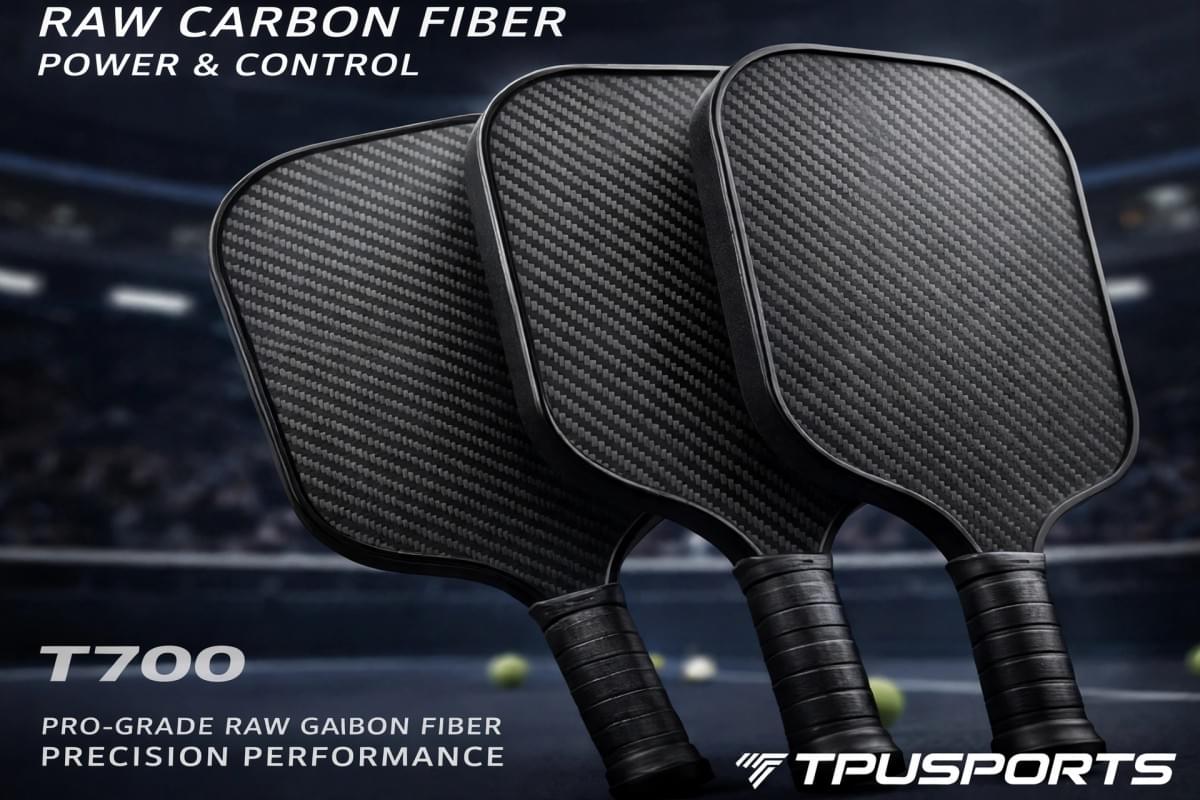
T300 and T700 are the same family — with adifferent strength ceiling
Both grades are standard-modulus carbonfibers first developed for aerospace and sporting goods, and the number signals the fiber's tensile strength class. T300 has a tensile strength of about 3,530
MPa. T700 reaches about 4,900 MPa — roughly 40% stronger — at a similar weight
and stiffness. That strength headroom matters in twoplaces on a paddle. The face can be laid up to feel more responsive without becoming fragile, and the surface holds up better over thousands of ballimpacts, which is exactly where cheaper paddles start to feel inconsistent. At TPU Sports, we build with Japanese-imported prepreg in T300, T700, and T1200, so a brand can match fiber to price point instead of accepting whatever a supplier has in stock.
On court, T700 feels crisper — and staysthat way longer
Players describe the difference in simplewords: pop, crispness, and consistency. A T700 face returns energy more evenly across the hitting surface, so off-center shots lose less pace and the sweet spot feels larger. Its texture also holds its grit longer, so the spin customers feel in week one is closer to what they feel in month three.
A well-made T300 paddle is not a badpaddle. It offers a slightly softer, more forgiving feel that many beginners prefer, and it is durable enough for recreational and club play. The gap appears under heavy use: high-volume players, long drilling sessions, and hard hitters wear a T300 face sooner — and that wear eventually shows up in reviews and warranty claims.
T300 vs. T700 at a glance
T300 vs T700 — Quick Comparison
Tensile strength: T300 — About 3,530 MPa | T700 — About 4,900 MPa
Feel: T300 — Softer, more forgiving | T700 — Crisper, more pop
Spin texture life: T300 — Good | T700 — Longer-lasting
Heavy-play durability: T300 — Solid | T700 — Excellent
Best for: T300 — Value lines, first runs | T700 — Performance brands
Typical US retail tier: T300 — $60–$120 | T700 — $140–$220
T700 costs more per paddle — and lets youcharge much more
Fiber is only one part of a paddle's cost,so moving from T300 to T700 does not double your factory price. It adds a premium per unit that most brands recover many times over at retail. In the US market, T300 paddles typically compete in the $60–$120 value and mid-range tier, where shoppers compare prices first. T700 is the expected standard in the $140–$220 performance tier, where shoppers compare specifications, watch review videos, and pay for a brand they trust.
That positioning gap is the real decision.If your brand story is pro-level performance, a T300 spec sheet will quietly undermine it the moment a reviewer points it out. If your story is the best
paddle under $100, T700 may add cost your customer never asked for.
Choose the grade that matches the brandyou are building
Choose T300 if youare launching a value line, a promotional range, or a first test order to
validate designs and artwork. It keeps your entry price sharp and your risk low.
Fiber grade alone does not make a greatpaddle
One honest warning: the label is not thepaddle. Core construction, layup design, edge treatment, and quality control can matter more than the fiber grade. A well-built T300 paddle on a quality
polypropylene honeycomb core will outplay — and outlast — a poorly built T700 every time. That is why every TPU Sports design goesthrough 14 performance tests, from weight and swing weight to face durability and shot consistency, and is built to USA Pickleball technical standards. When you evaluate any factory, including us, ask how the paddle is tested, not only which fiber it uses.
Decide with two paddles in your hands, nottwo spec sheets
The fastest way to choose is to play both.We can produce T300 and T700 samples with your own logo and graphics, so you and your testers can feel the difference before you commit to a production run. TPU Sports is a Guangzhou-based OEM factory with more than 10 years of carbon
fiber experience, over 100 brand partners, and 200,000+ paddles shipped to the
United States, Canada, and Europe.
Last but not the least, tell us your target retail price, yourexpected first quantity, and where you plan to sell, and we will recommend the grade, core, and surface that fit — even if that recommendation is the cheaper one. Request your samples today, and launch with a specification you can defend
in every review.
Get T300 and T700 samples with your logo
Send us your target retail price and first-orderquantity. We will recommend a grade and build both samples so you can play-test the difference before you commit. MOQ from 100 paddles • www.tpusports.com