
Ask any paddle manufacturer which specification generates the most questions, and thickness will be near the top of the list.
It is a single number — 13mm, 14mm or 16mm — yet it changes how a paddle feels, how much power it produces, how large the sweet spot is, and who the paddle is actually for.
At TPU SPORTS, we produce pickleball paddles in all three thicknesses for OEM and ODM customers. This article explains what thickness really does, how each option behaves on court, and how a brand should decide which one to build.
PICKLEBALL PADDLE THICKNESS
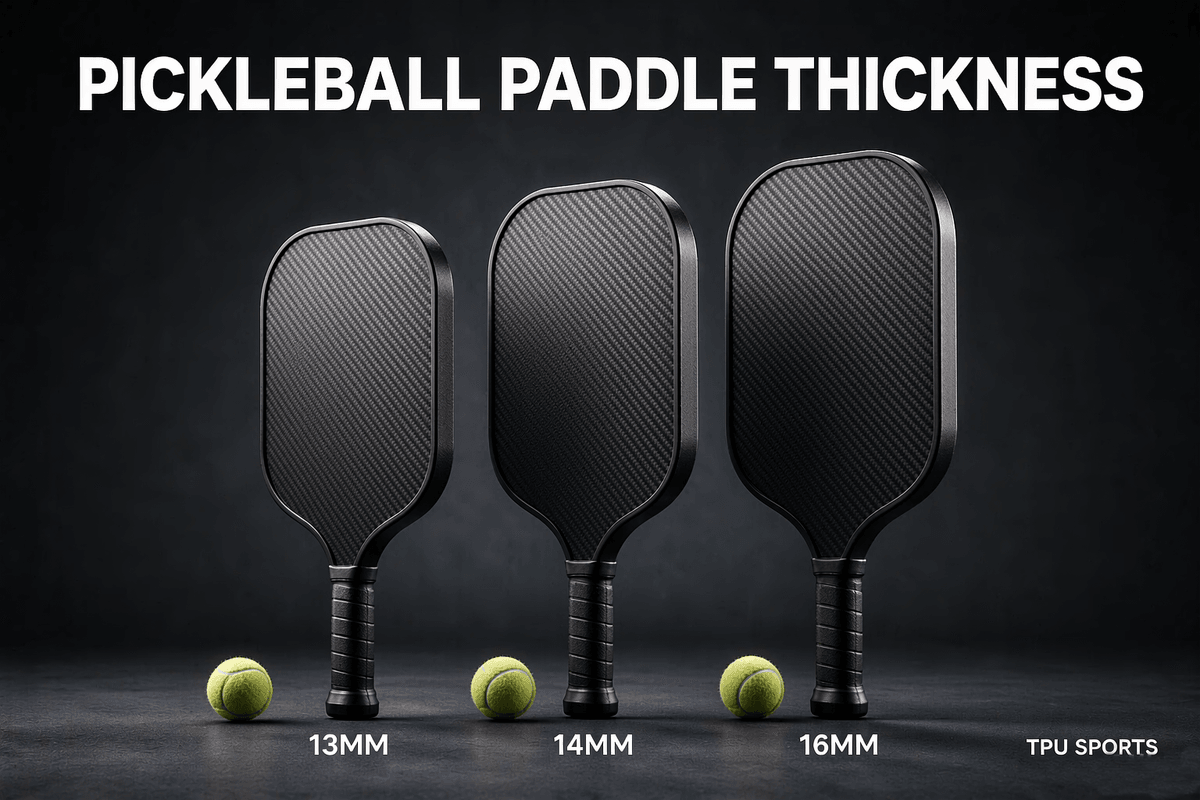
Quick Answer: 13mm vs 14mm vs 16mm
If you only read one paragraph, read this one.
13mm paddles are the thinnest of the three. The core flexes and recovers quickly, so energy returns to the ball fast. The result is more power and pop, with a crisper — but firmer — feel.
14mm sits in the middle. It keeps much of the responsiveness of a thin core while adding stability and a slightly larger sweet spot. It is the most versatile starting point for a paddle line.
16mm is the thickest common option and the current mainstream for high-end paddles. The core absorbs more impact energy, producing a softer, more stable, more controlled feel with a larger sweet spot — at the cost of some raw power.
None of the three is "best". A 13mm built for aggressive drives and a 16mm built for dinks and drops can both be correct products — for different players.
13mm vs 14mm vs 16mm: Comparison Table
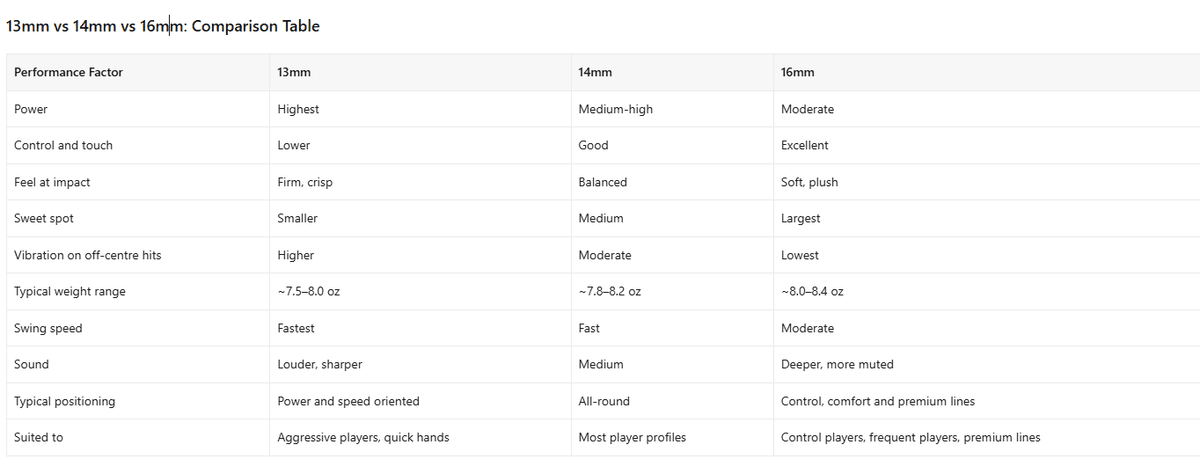
The rest of this article explains where each number comes from — and where the exceptions are.
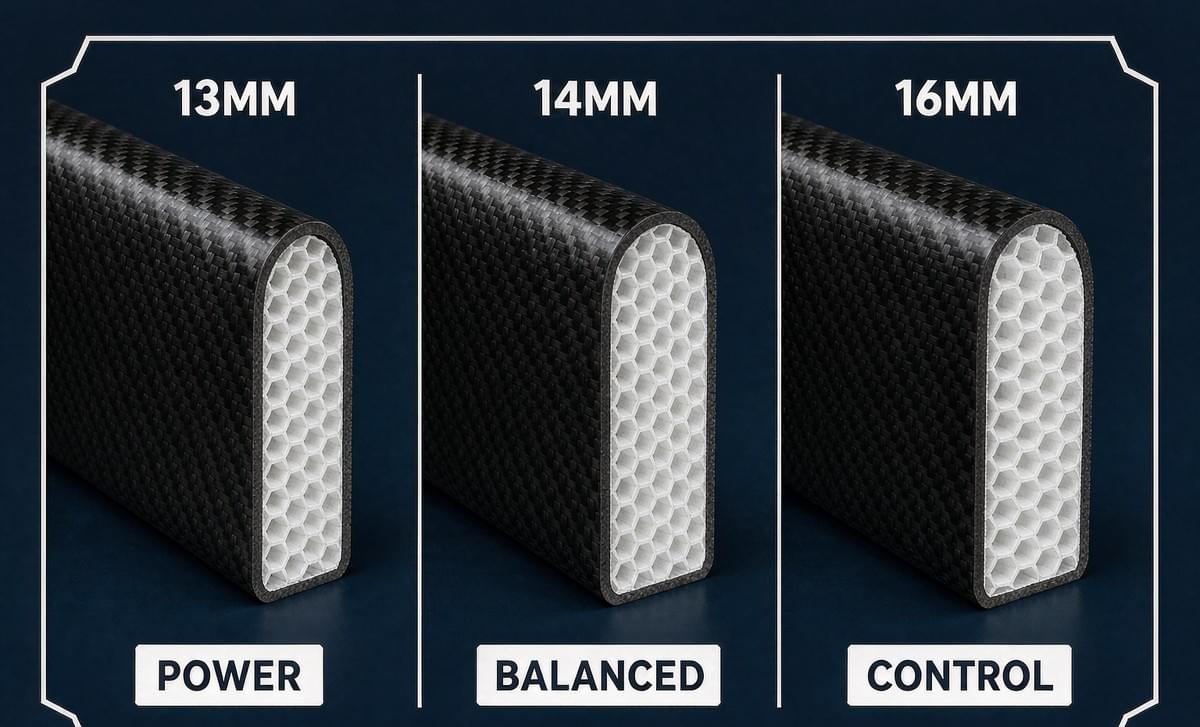
13MM POWER / 14MM BALANCED / 16MM CONTROL
What Thickness Actually Does: The Physics in One Minute
A paddle is a sandwich: two face sheets bonded around a honeycomb core. Thickness changes how that sandwich responds when a ball hits it.
A thinner core is stiffer in feel. It compresses and recovers quickly, returning energy to the ball in a short, sharp impulse. Players experience this as pop and drive power.
A thicker core is better at absorbing energy. It compresses more deeply on impact, holding the ball slightly longer and spreading the load across more of the face. Players experience this as a softer feel, more stability, and a more forgiving response on off-centre hits.
Neither behaviour is better. They are two different answers to the same question: what should the paddle do with the energy of impact?
Everything else — weight, balance, spin, sound — follows from this starting point.
13mm Paddles: Built for Power and Hand Speed
A 13mm construction is developed around responsiveness.
What it delivers:
The fastest energy return of the three — drives and counters carry more pace
- A crisper, more direct feel at contact
- Lower static weight in most builds, which supports quick hand battles at the kitchen line
The trade-offs:
- A smaller effective sweet spot
- More vibration reaching the hand on off-centre hits
- A firmer overall feel that some recreational players find harsh
- Who it suits: intermediate and advanced players who hit through the ball, players coming from tennis, and products positioned explicitly as "power paddles".
For a brand, a 13mm paddle is a clear, easy-to-communicate product story — but it is a narrower story than 14mm or 16mm.
14mm Paddles: The Middle Path
The 14mm construction is the compromise most players actually want, whether they know it or not.
It keeps a lively, responsive feel while adding enough core depth to soften the harshness of thin builds. The sweet spot grows, off-centre hits stay playable, and the paddle remains quick through the air.
What it delivers:
- A genuine balance of power and control
- Medium swing weight and medium stability
- The widest addressable audience of the three options
The trade-offs:
- It does not maximise any single attribute — a 14mm will not out-drive a well-built 13mm or out-touch a well-built 16mm
- For a brand, this is usually the first thickness to launch: it suits the broadest buyer profile and the largest market segment. In our own production experience, midweight paddles in the 7.3–8.4 oz range account for the majority of OEM order volume, and 14mm constructions sit comfortably in the middle of that band.
16mm Paddles: The Current Premium Standard
Walk through the premium sections of any paddle retailer today and you will notice that 16mm dominates.
The reason is straightforward: a thicker core absorbs vibration and stabilises the face, which produces the soft, "plush" feel that experienced players describe as easier to control — especially in the soft game of dinks, drops and resets.
What it delivers:
- The largest and most forgiving sweet spot
- The lowest vibration on off-centre hits
- A deeper, more solid sound at contact
- Excellent dwell time for spin-oriented strokes
The trade-offs:
- Less raw pace on drives
- Slightly higher static weight in equivalent builds — which is why weight control matters more at 16mm than at 13mm
- A slower feel that pure power players may not prefer
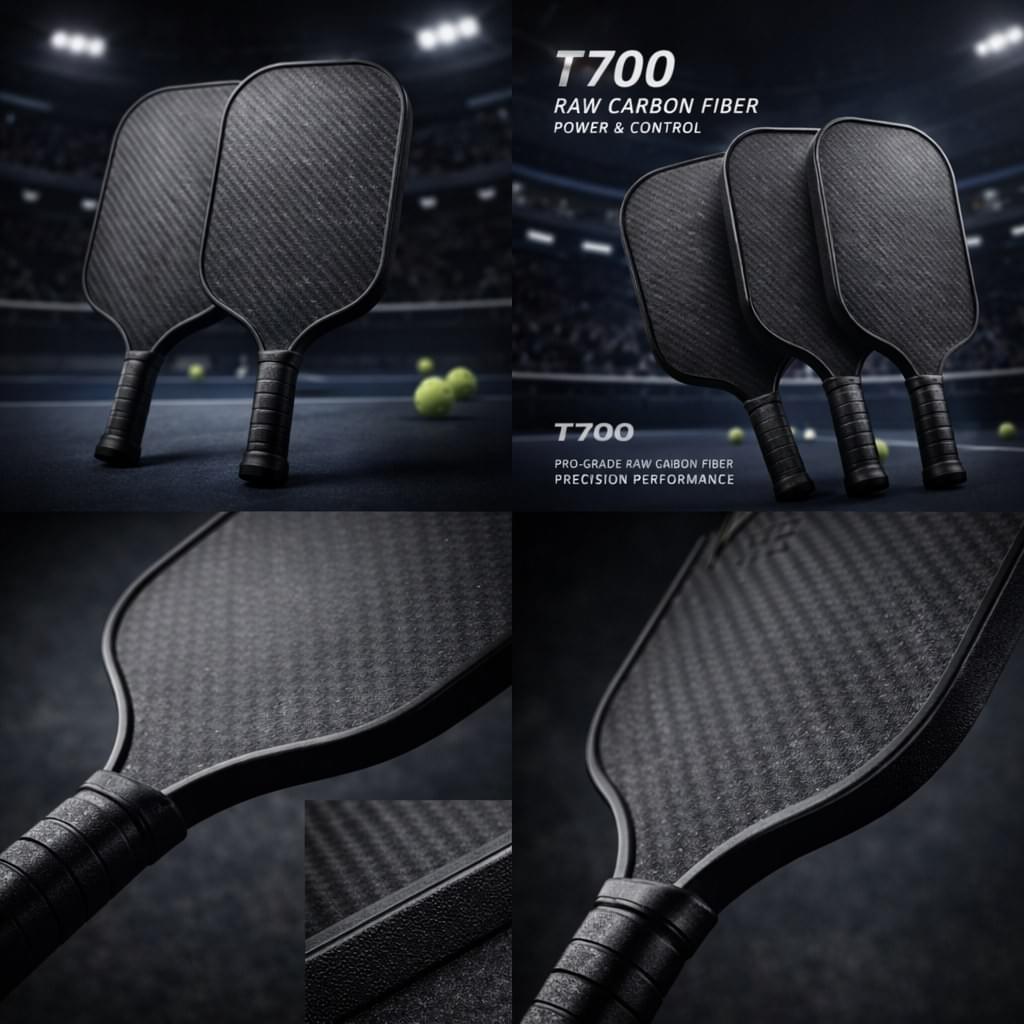
Who it suits: control-oriented players, frequent players who care about joint comfort, and premium product lines. It is no coincidence that the "standard picture" of a high-end 2026 paddle — thermoformed construction, foam-injected edge, T700 raw carbon face — is usually built around a 16mm high-density PP honeycomb core.
One practical note for buyers: when a 16mm build is the goal, the weight tolerance specification matters. A 16mm paddle that drifts above ~8.4 oz loses the quickness that the core's control benefits are supposed to deliver. This is a core supplier question, not just a number on a spec sheet.
How Thickness Interacts With Everything Else
Thickness never acts alone. When a brand sets a thickness, several other specifications must move with it.
Thickness and Weight
A thicker core uses more material, so — all else being equal — a 16mm build is heavier than a 13mm build of the same face and shape.
The market's weight bands put this in context:
Lightweight: under ~7.3 oz (207g) — maximum quickness, popular with faster hands at the net
Midweight: 7.3–8.4 oz (207–238g) — the mainstream segment where roughly 80% of players sit, and where most OEM volume ships
Heavyweight: above ~8.5 oz (241g) — more mass behind the ball, at the cost of swing speed
A practical benchmark: the "golden zone" for the US and European markets is a midweight build around 7.8–8.2 oz (220–232g). A 13mm build reaches it easily; a 16mm build has to be engineered — with core density, face material and grip weight — to stay inside it.
Thickness and Balance
Two paddles of the same weight can feel completely different depending on where that weight sits. Thickness adds mass at the face, so it tends to push the balance point towards the head. That increases stability and leverage but slows hand speed. This is why balance point and swing weight must be re-checked whenever thickness changes.
Thickness and Spin
Spin is primarily a function of the face — its texture and friction — not the core. What thickness contributes indirectly is dwell time: a thicker, more compliant core holds the ball a fraction longer, which gives the surface slightly more contact time to impart rotation. It is a secondary effect; the face material remains the main lever. (See our comparison of Kevlar and carbon fiber faces for that side of the equation.)
Thickness and Sound
Sound is a useful quality signal. Thin cores sound louder and sharper; thick cores sound deeper and more muted. A hollow or inconsistent sound along the edge, however, points to a construction problem — insufficient edge foam or poor bonding — rather than to thickness itself.
Common Misconceptions About Paddle Thickness
1. "Thicker always means better."
16mm is popular because it matches what premium buyers want, not because it is objectively superior. A poorly built 16mm paddle with a low-density core will feel worse than a well-built 14mm.
2. "Thickness alone determines power."
Power comes from the whole system: core material, core thickness, face stiffness, total weight, balance and construction. A 13mm with a soft face and heavy swing weight will not automatically play "powerful".
3. "The number refers to the core."Not always."
Some brands label total paddle thickness; others label the core alone. When comparing supplier quotations, confirm which convention is being used — a 16mm total and a 16mm core are not the same paddle.
4. "Beginners should always start thick."
Beginners benefit from forgiveness, which 16mm provides — but many beginners also generate slower swing speeds and may prefer the livelier response of a 14mm. Player testing beats rules of thumb.
5. "Thickness does not affect certification."
Certification depends on the finished paddle. Changing thickness changes deflection and other measured behaviour, so any thickness change should be re-tested against current USA Pickleball requirements before it goes to production.
How Brands Should Choose: A Practical Framework
Step 1 — Start from the player, not the number.
Define who the paddle is for before touching the spec sheet.
Step 2 — Map thickness to the product promise.
- Power, speed, attacking play → 13mm
- Balanced all-round line, broadest audience → 14mm
- Control, comfort, premium positioning → 16mm
Step 3 — Lock the weight window together with the thickness.
Decide the target weight range at the same time. A 16mm build with a 7.8–8.2 oz target is a different engineering task from a 16mm that drifts to 8.5 oz.
Step 4 — Match the face and core to the thickness.
A thin core with a very soft face behaves differently from a thin core with a stiff face. Read our guide to EPP and PP honeycomb cores to understand the core side of this decision.
Step 5 — Prototype at two thicknesses, not one.
For a new line, producing 13mm and 16mm samples (or 14mm and 16mm) of the same face and shape is the fastest way to find where the product should sit. Player feedback at this stage is cheap; changing the mould after production is not.
Step 6 — Verify the specification in writing.
Confirm with the manufacturer whether the quoted thickness is total thickness or core thickness, what the weight tolerance is (±5g is a reasonable professional standard), and how consistency is controlled across a production run.
▼ THE ART OF THE PADDLE
How TPU SPORTS Supports Thickness Development
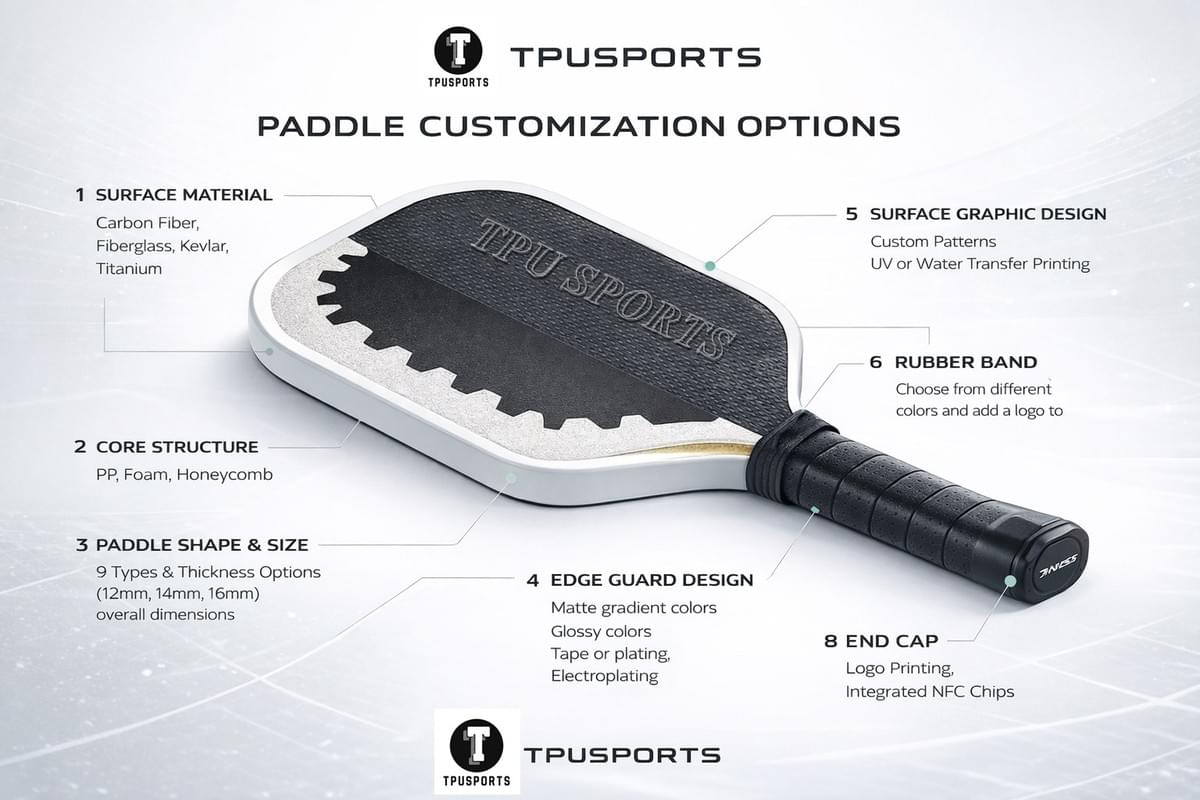
TPU SPORTS manufactures OEM and ODM pickleball paddles for brands, distributors, retailers, clubs and sports businesses. Thickness-related capabilities include:
13mm, 14mm and 16mm constructions — plus custom thicknesses by project
- PP honeycomb, EPP and MPP hybrid cores, with density options matched to each thickness
- Thermoformed (unibody) and cold-pressed construction
- Foam-injected edges for enlarged sweet spots and higher twist weight
- T700 raw carbon, Kevlar/aramid, fiberglass and titanium composite faces
- Weight targeting and tolerance control (typically ±5g)
- Balance point and swing weight tuning
- Custom shapes, grips, edge guards, graphics and private label packaging
- Prototype development with multi-thickness sample runs
- We build thickness as part of a complete specification — player, shape, face, core, weight and balance — rather than as a number on a form.

Final Thoughts
Thickness is one of the highest-leverage choices in paddle development because it changes the character of the product more visibly than almost any other single specification.
13mm buys power and hand speed. 16mm buys comfort, stability and control. 14mm buys the middle ground — and the largest market.
For players, the fastest way to a preference is to hit both ends of the range and notice where your game feels better. For brands, the fastest way to a product decision is the same: prototype two thicknesses, put them in real players' hands, and let the feedback choose the production spec.
The best thickness is not the thickest one or the most popular one. It is the one that matches the player the paddle was designed for.
Start Your Pickleball Paddle Project
Are you developing your own pickleball paddle brand?
TPU SPORTS can help you move from concept and prototype to OEM production — including paddle thickness, core, face material, construction, shape, weight, balance, grip and packaging.
Contact TPU SPORTS to discuss your requirements and develop your next pickleball paddle.
Website: www.tpusports.comOEM / ODM: Pickleball Paddle • Pickleball Ball • Pickleball Net
FAQs
1. What is the difference between a 14mm and 16mm pickleball paddle?
A 14mm paddle can be developed for a more responsive and powerful feel, while a 16mm paddle generally offers greater stability, a larger sweet spot, and a softer, more controlled response. Actual performance also depends on the core, surface, weight and construction.
2. Is a thicker pickleball paddle better for beginners?
A thicker core is more forgiving — it absorbs vibration and enlarges the sweet spot, which many beginners appreciate. However, some beginners prefer the livelier response of a 14mm build. Testing with real players is more reliable than any fixed rule.
3. Does thickness affect spin?
Only indirectly. Spin comes mainly from the face material's texture and friction. A thicker core can hold the ball slightly longer at contact, but the face remains the primary driver of spin performance.
4. Does a thicker paddle weigh more?
Generally yes, if everything else is the same — a thicker core uses more material. This is why weight targeting matters most at 16mm: the build must be engineered to stay within the intended weight window.
5. What thickness do professional players use?
Most competitive paddles cluster in the 14–16mm range, with 16mm common in premium control-oriented models. Player preference varies widely, and many pros adjust weight and grip size rather than core thickness.
6. Is 13mm too thin for frequent play?
Not at all. 13mm suits players who prioritise power and hand speed. Frequent players who are sensitive to vibration may prefer 14mm or 16mm, but a well-built 13mm with a quality core and solid edge construction remains a durable choice.
7. Can I customize the paddle thickness at TPU SPORTS?
Yes. Standard options are 13mm, 14mm and 16mm, with other specifications available depending on the product design. We recommend prototyping at two thicknesses before committing to mass production.