
Choosing a paddle face material is one of the first decisions a brand has to make — and one of the most misunderstood.
Kevlar and carbon fiber are both high-performance fibers used in applications far beyond sport. But once they are bonded to a honeycomb core and hit with a plastic ball several hundred thousand times, they behave very differently.
At TPU SPORTS, we manufacture pickleball paddles for brands, distributors, retailers and clubs. We build Kevlar paddles, carbon fiber paddles, and hybrid faces that combine the two. This article compares the materials the way we actually discuss them with a customer who is deciding on a new product line.
Kevlar (aramid) versus T700 raw carbon fiber paddle faces.
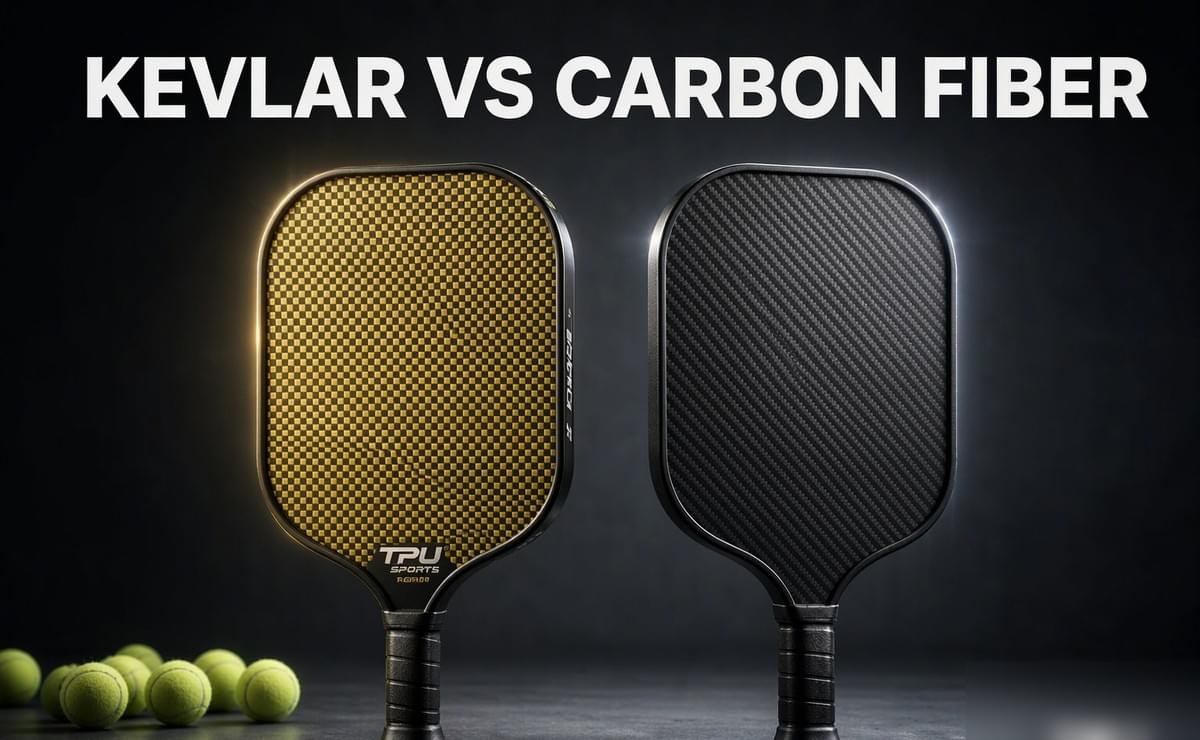
Quick Answer: Kevlar vs Carbon Fiber
If you only read one paragraph, read this one.
Kevlar (aramid fiber) produces a softer, more forgiving paddle face. It absorbs vibration well, resists impact damage, and holds the ball slightly longer on the face. Brands typically choose it when the product targets comfort, control, joint-friendly feel or maximum durability.
Carbon fiber — particularly T700 raw carbon — produces a firmer, more responsive face. Power transfer is more direct, feedback is crisper, and a peel-ply surface weave generates more spin. It is the default choice for high-performance and competitive paddles.
Hybrid faces combine carbon fiber and Kevlar in the same laminate to balance power with comfort and durability.
There is no universally better material. The right choice depends on the target player, the product positioning, and the retail price the paddle needs to support.
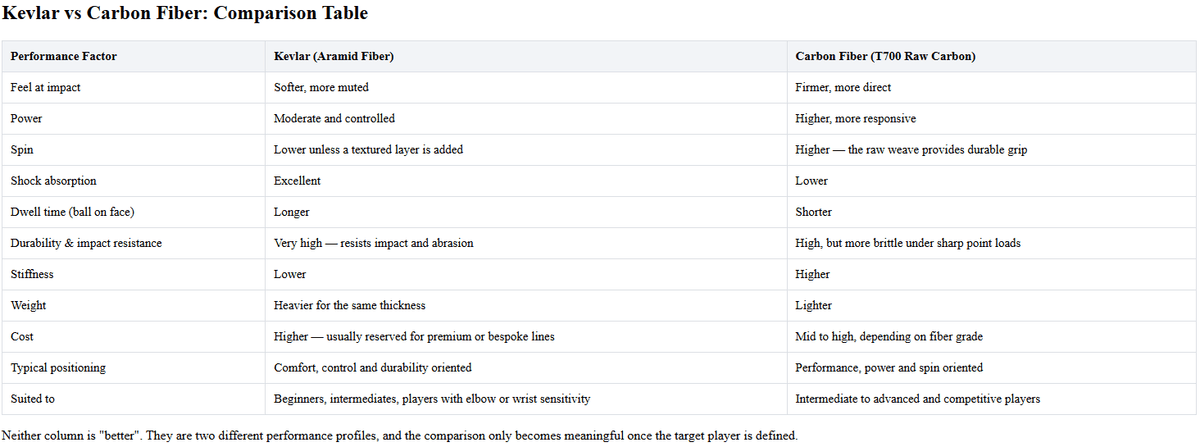
Kevlar vs Carbon Fiber: Comparison Table
What Is a Kevlar Pickleball Paddle Face?
Kevlar is the DuPont trade name for aramid fiber. Aramid fibers are known for an unusual combination of properties: high tensile strength, very high toughness, excellent impact resistance, and low density.
It is the same material family used in ballistic protection, tyres, aircraft components and marine hulls — applications where absorbing energy without cracking matters more than stiffness.
How Kevlar Behaves on a Paddle Face
When aramid fiber is used as a paddle face, it flexes slightly on impact and damps vibration. Players describe the result as a softer, more "held" feeling, with a longer dwell time — the ball stays on the face a fraction longer before leaving.
That has two practical consequences:
- More comfort. Vibration reaching the hand and elbow is reduced, which matters for players who play several times a week or who are sensitive to harsh feedback.
- More forgiveness on off-centre hits. A slightly more flexible face tends to feel less punishing when the ball is not struck cleanly.
The trade-off is that Kevlar alone generally produces less pop and less spin than raw carbon fiber. That is exactly why hybrid constructions exist.
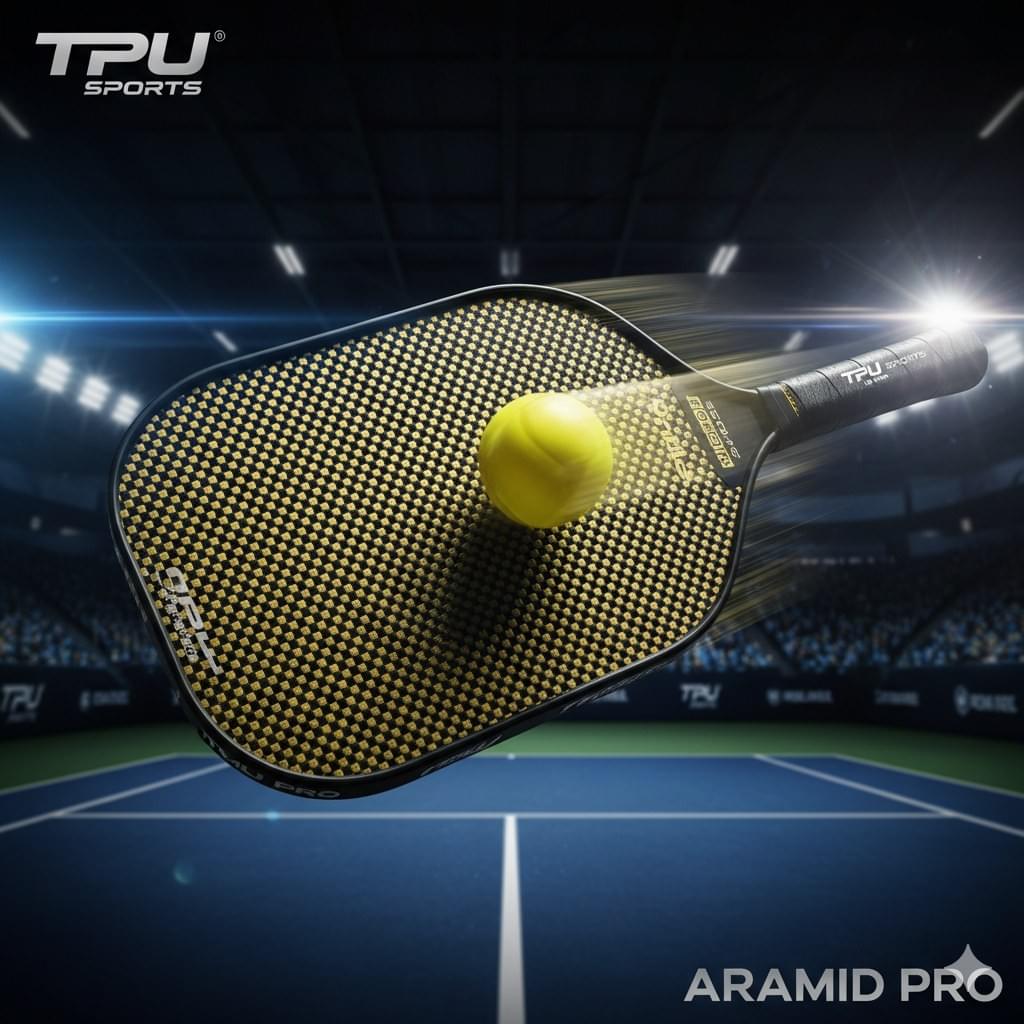
Kevlar aramid fiber woven face — Aramid Professional Series.
A Note on Nomex
You will sometimes see "Nomex" mentioned alongside Kevlar. Both are aramid materials, but they are used differently. In paddle construction, Nomex is typically used as a core material, not a face material. Kevlar and Nomex should not be treated as interchangeable terms in a specification sheet.
What Is a Carbon Fiber Pickleball Paddle Face?
Carbon fiber is the most widely used performance face material in pickleball. It offers an excellent stiffness-to-weight ratio, which is why it dominates aerospace, motorsport and high-end sporting goods.
Not all carbon fiber is the same. Two variables matter most in paddle development.
1. Fiber Grade
The most commonly referenced grade is T700, a standard-modulus carbon fiber produced by Toray of Japan. T700 has become the industry benchmark for performance paddles because it combines good strength with toughness and consistent processing behaviour.
T300 is a lower grade. It is cheaper and more brittle, and is usually found in entry-level paddles.
For a brand, the practical question to ask a manufacturer is not "is it T700?" but "is it genuine Toray T700, and can you provide material traceability?" There is a meaningful difference between imported Toray tow and domestic fiber sold as "T700 equivalent".
2. Weave Construction — 3K, 12K, 18K
The "K" number refers to the number of filaments in each fiber tow. 3K means 3,000 filaments per bundle; 18K means 18,000.
- 3K — a tighter, denser weave. Feels firmer and crisper at impact.
- 12K / 18K — wider tows, larger visible pattern. Generally softer in feel with more vibration damping.
Weave affects feel and appearance, but it does not replace the fiber grade. A 3K face made from a poor grade of carbon will still underperform.
3. Raw Carbon and Peel-Ply Texture
"Raw carbon" refers to a face where the texture comes from the fabric itself rather than a sprayed-on grit coating. During lamination, a peel-ply layer is removed after curing, leaving the exposed weave pattern.
This matters for spin. A sprayed grit surface wears down with use and its friction drops. A peel-ply raw carbon surface keeps the friction of the weave, so spin performance degrades far more slowly. It is one of the most common questions buyers should ask about any "high-spin" paddle.
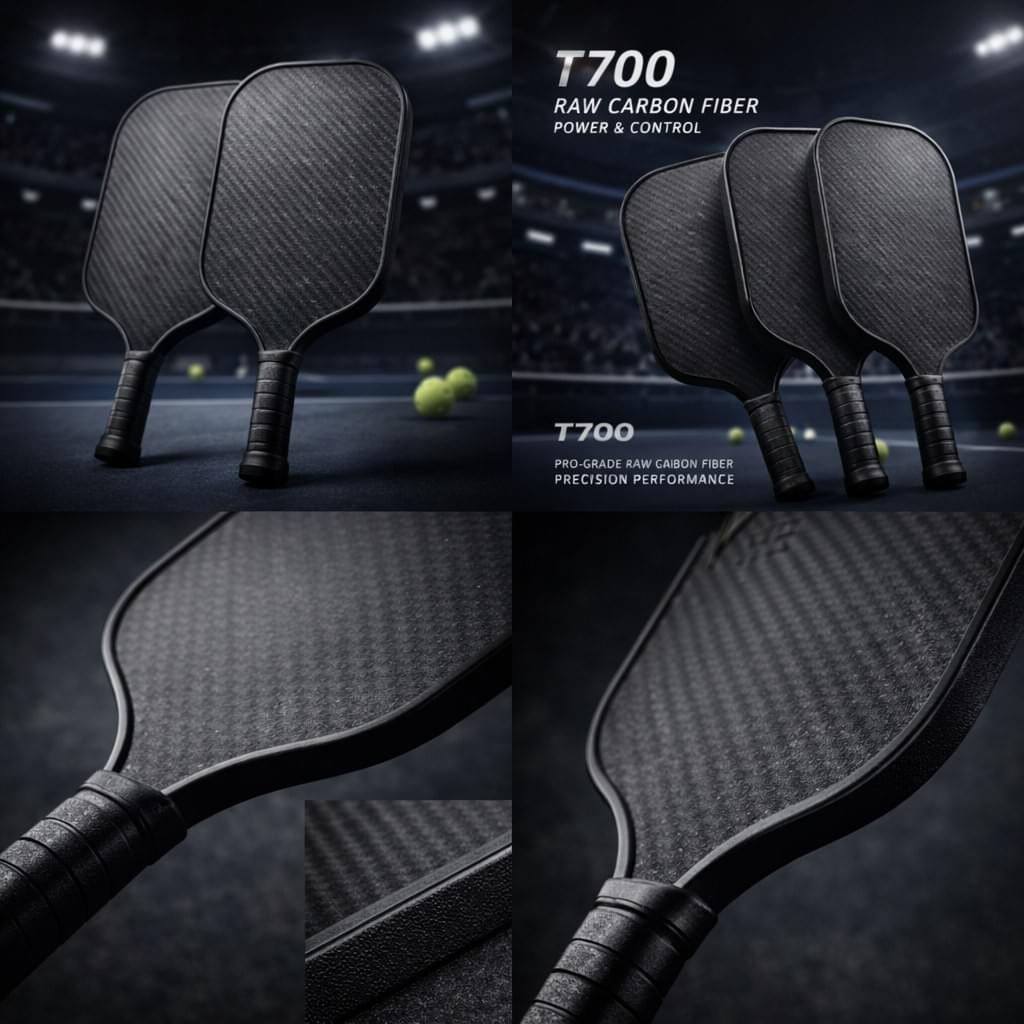
T700 raw carbon fiber face with visible twill weave.
1. Feel and Feedback
Kevlar feels softer. Impact energy is partially absorbed by the fiber, so fewer vibrations reach the handle. Carbon fiber feels firmer and transmits more information back to the hand.
For a beginner, that softer feel is often more enjoyable. For an advanced player who reads the ball off the face, firmer feedback is usually preferred.
2. Power and Control
Carbon fiber generally produces more power because it is stiffer and returns energy more directly. Kevlar, being more compliant, tends to produce a slower, more controlled response.
This is why aggressive, drive-heavy players gravitate towards carbon, while control-first players — particularly those who rely on dinks, drops and placement — often prefer Kevlar or hybrid faces.
3. Spin Performance
Spin depends on the surface's ability to grip the ball, which is a function of texture and friction rather than the fiber type alone. In practice:
- Raw carbon with a peel-ply weave is the strongest spin platform.
- Kevlar's woven surface can be engineered for grip too, but aramid fiber is more abrasion-resistant than it is high-friction, so it is usually paired with a textured laminate in spin-oriented products.
4. Shock Absorption and Comfort
This is Kevlar's clearest advantage. Aramid fiber is exceptionally good at absorbing impact energy without cracking. Paddles built with Kevlar faces — especially combined with a thermoformed, foam-injected edge — tend to produce noticeably less vibration and a more comfortable feel over long sessions.
For brands targeting older players, players returning from injury, or the fast-growing recreational segment, this is a genuine and defensible product story.
5. Durability
Both materials are durable, but they fail differently.
Carbon fiber is strong and stiff, but relatively brittle. Under repeated sharp point loads — edge impacts, court scrapes, drops — it can crack or delaminate.
Kevlar is tougher. It absorbs impact and resists abrasion, which is precisely why it is used in protective equipment. A Kevlar face or a hybrid laminate is generally more resistant to impact damage over the life of the paddle.
If the positioning is "the paddle that lasts", Kevlar has the stronger technical argument.
6. Weight
For the same thickness, Kevlar is heavier than carbon fiber. In a 16mm paddle where total weight is already targeted at around 220–240g, this matters.
A heavier face shifts the balance point towards the head. That can add stability and leverage, but it reduces maneuverability. It is one of the reasons manufacturers often use a hybrid layup rather than a full Kevlar face: they want the damped feel without an unmanageable swing weight.
7. Cost
Kevlar sits above standard carbon fiber on cost, and hybrid layups add processing complexity — more layers, more careful resin control, higher reject rates during lamination.
In our own quotation experience, a Kevlar or hybrid construction typically lands in the premium or bespoke tier, above a standard thermoformed T700 paddle. That is a positioning decision as much as a material one: a brand choosing Kevlar is usually choosing to compete on feel and durability rather than on price.
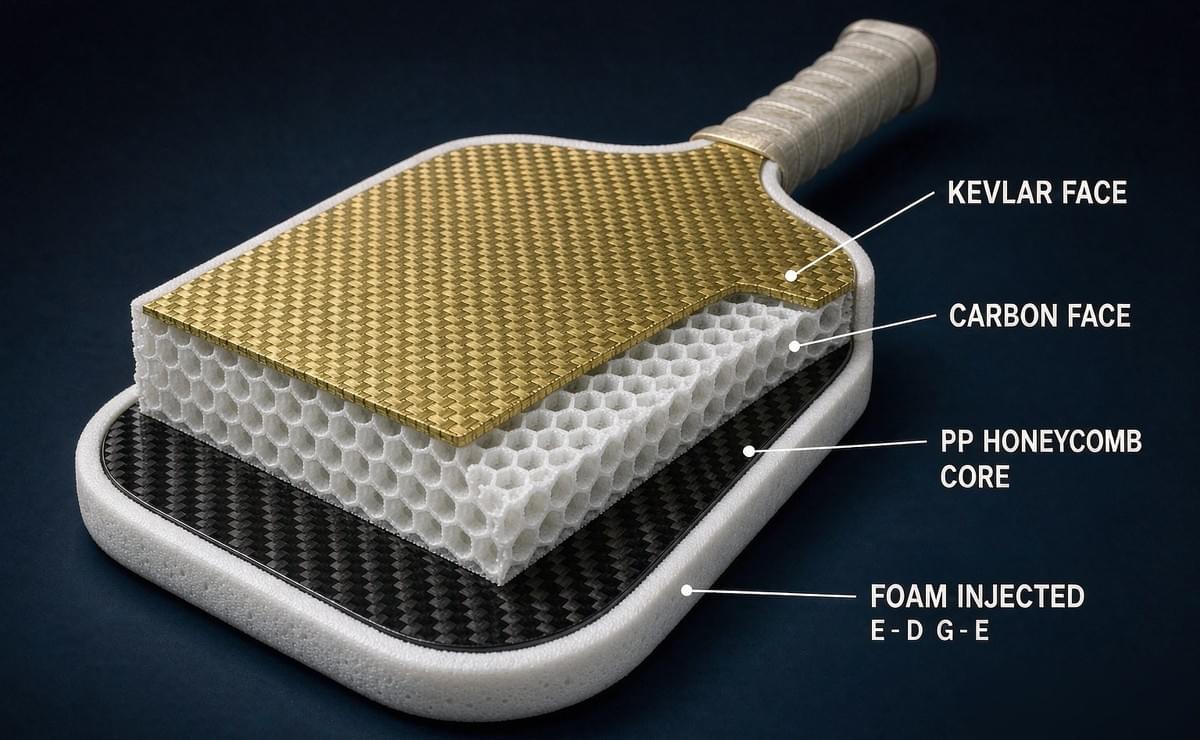
Layered construction: Kevlar face, PP honeycomb core, carbon fiber face, foam-injected edge.
Hybrid Faces: Carbon Fiber + Kevlar
The most common answer to "Kevlar or carbon?" is: both.
A hybrid laminate stacks carbon fiber and aramid fiber in the same face. The carbon layer provides stiffness, power and a spin-capable weave; the aramid layer adds toughness, damping and impact resistance.
Hybrid layups let a manufacturer tune performance rather than pick a single extreme:
- More carbon plies → firmer, more powerful, more spin
- More aramid plies → softer, more comfortable, more durable
For a brand, hybrid construction is also a differentiation tool. It produces a paddle that cannot be described as simply "another carbon paddle", and it gives the sales team a technical story that is easy to explain to a buyer.
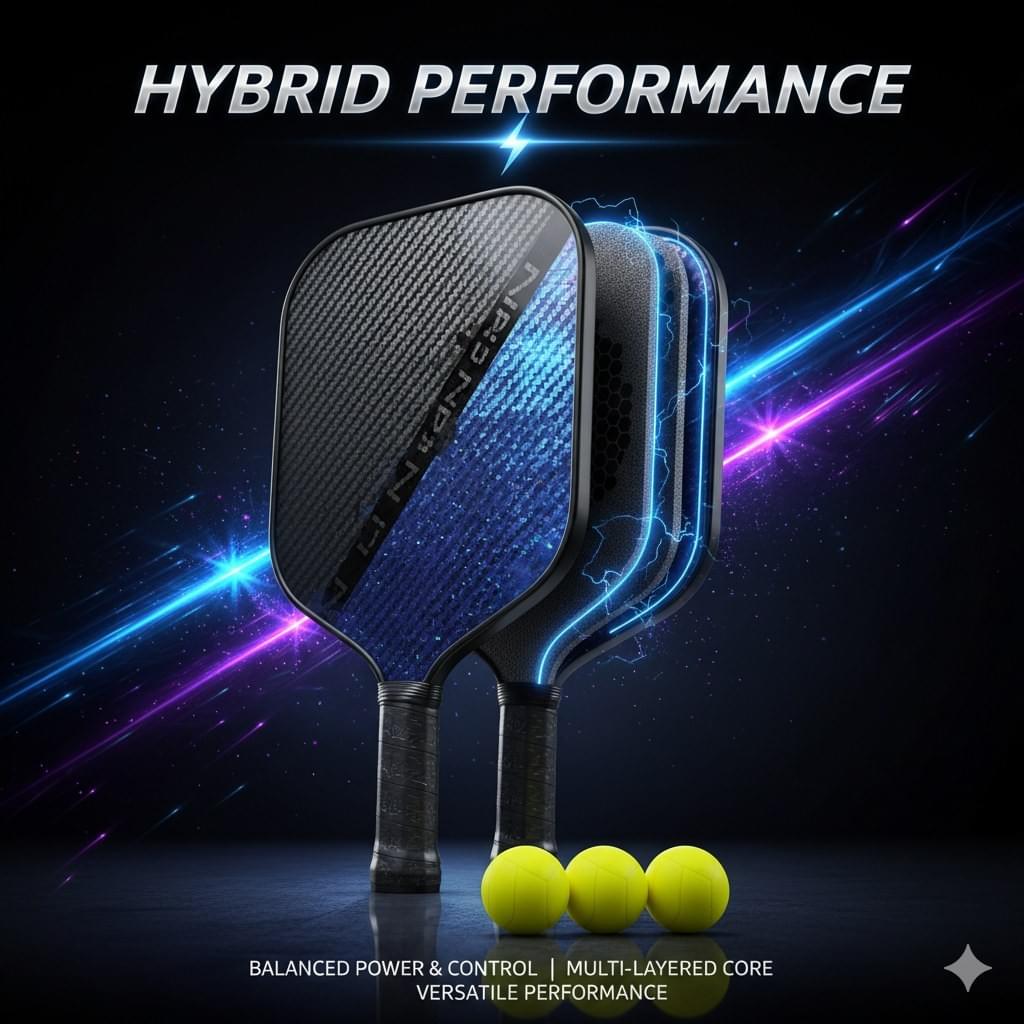
Hybrid Performance Series — carbon and aramid layers combined.
1. "Kevlar is old technology."
Aramid fiber is mature, not obsolete. Maturity means stable supply, predictable processing and well-understood performance — which is exactly what a production line wants.
2. "Carbon fiber is always more powerful."
A stiff face returns energy efficiently, but power also depends on core, thickness, total weight and balance. A 16mm carbon paddle can feel less powerful than a thinner Kevlar build if the specification is wrong.
3. "More expensive material means better performance."
Cost does not map to performance. It maps to positioning. A well-specified T700 paddle with the right core can outperform a poorly engineered premium-material paddle.
4. "Spin comes from the material."
Spin comes from surface friction and texture. Raw carbon peel-ply is popular because the friction is structural and durable — not because carbon fiber is inherently a spin material.
5. "Kevlar and Nomex are the same thing."
They are both aramids, but in paddle construction Kevlar is a face material and Nomex is a core material. Using the terms interchangeably in a spec sheet signals inexperience.
How Brands Should Choose: A Practical Framework
Rather than starting with the material, start with the player and work backwards.
Step 1 — Define the target player.
Beginner, recreational, intermediate, advanced, or tournament? Age and physical profile matter as much as skill level.
Step 2 — Define the primary promise.
Is the paddle sold on power, on control, on comfort, or on durability? Only one can lead.
Step 3 — Choose the face material to match.
- Comfort, control, longevity → Kevlar or Kevlar-dominant hybrid
- Power, spin, competitive performance → T700 raw carbon
- Balanced, differentiated product → hybrid layup
Step 4 — Match the core and thickness.
Face material never works alone. Core type and thickness set the baseline feel; the face refines it. See our comparison of EPP and PP honeycomb cores for the core side of this decision.
Step 5 — Confirm construction.
Cold-pressed or thermoformed? Foam-injected edge or not? These choices affect stability, sweet spot size and perceived quality at least as much as the face material does.
Step 6 — Prototype and test.
Build samples at the target specification and test them with real players before committing to volume. Face material changes are cheap at prototype stage and expensive after production.
How TPU SPORTS Supports Kevlar and Carbon Fiber Paddle Development
TPU SPORTS manufactures OEM and ODM pickleball paddles for brands, distributors, retailers, clubs and sports businesses. Our face material capabilities include:
- T700 raw carbon fiber paddles
- Kevlar / aramid fiber paddles
- Carbon fiber and Kevlar hybrid laminates
- Fiberglass and titanium composite faces
- 3K, 12K and 18K weave options
- Peel-ply textured surfaces
- Thermoformed (unibody) construction with foam-injected edges
- Cold-pressed construction for value-oriented lines
- PP honeycomb, EPP and MPP hybrid cores
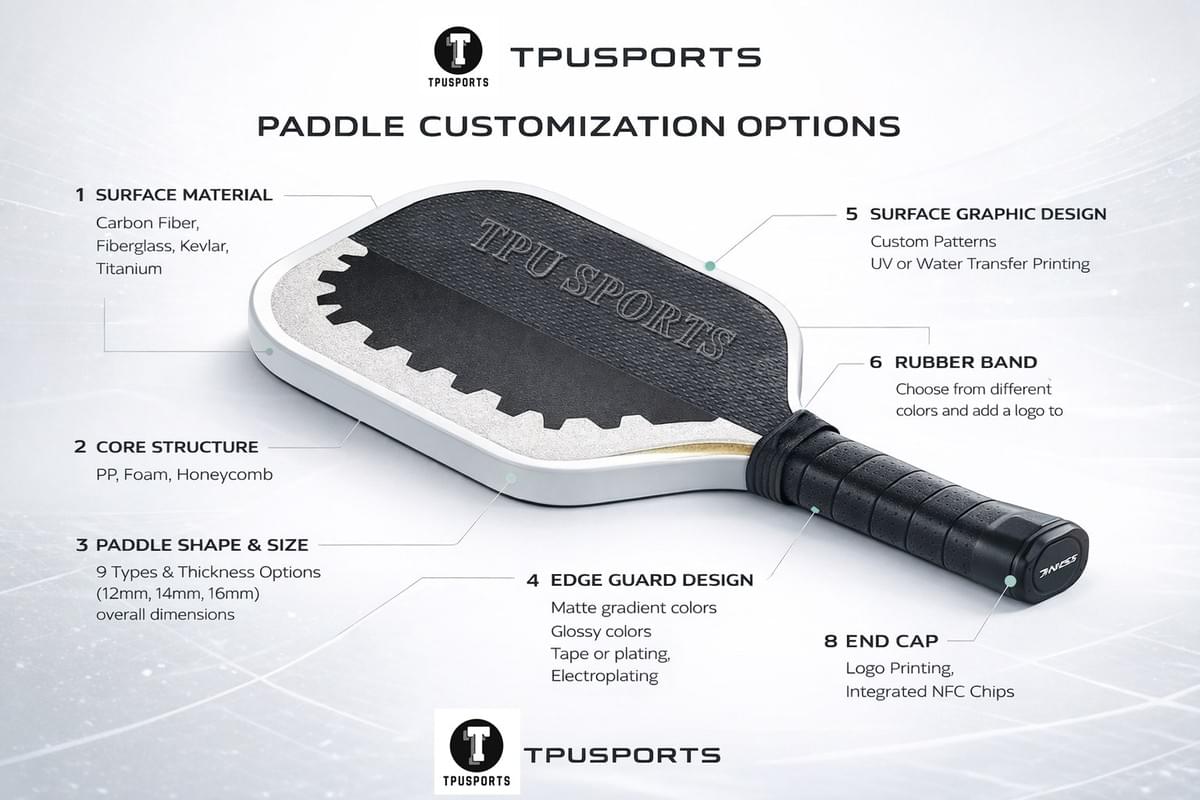
- Custom paddle shapes and thickness (13mm / 14mm / 16mm)
- Custom weight and balance targeting
- Custom grips, edge guards and end caps
- UV printing, water transfer and graphic design
- Private label packaging
- Prototype development through mass production
We do not simply laminate a customer's logo onto a paddle. We work with brands to select a face material, core and construction combination that fits the target player, the market positioning and the target retail price.
Paddle customization options available from TPU SPORTS.
Final Thoughts
Kevlar and carbon fiber are not competitors in the sense of one being newer or better. They are two different ways to solve the same problem, and each solves it for a different player.
Carbon fiber — especially T700 raw carbon — is the right answer when the product needs to win on power, spin and competitive credibility.
Kevlar is the right answer when the product needs to win on comfort, control and durability, or when the target market is recreational players who play often and value a forgiving feel.
Hybrid construction is the right answer when the brand wants both, and wants a paddle that is difficult to copy on a specification sheet.
The best face material is not the most expensive one. It is the one that matches the player the paddle was designed for.
Start Your Pickleball Paddle Project
Are you developing your own pickleball paddle brand?
TPU SPORTS can help you move from concept and prototype to OEM production — including paddle shape, face material, core, construction, thickness, weight, balance, grip and packaging. Learn more about how to choose the right pickleball paddle.
Contact TPU SPORTS to discuss your requirements and develop your next pickleball paddle.
Website: www.tpusports.com
OEM / ODM: Pickleball Paddle • Pickleball Ball • Pickleball Net
FAQs
1. Is Kevlar better than carbon fiber for a pickleball paddle?
Neither is universally better. Kevlar offers a softer feel, better shock absorption and higher impact durability. Carbon fiber offers more power, more direct feedback and stronger spin potential. The right choice depends on the target player and the product positioning.
2. What does Kevlar actually do in a pickleball paddle?
Kevlar, or aramid fiber, is used as a face material. It damps vibration, resists impact damage and lengthens dwell time, which produces a softer and more forgiving feel compared with a pure carbon fiber face.
3. Does a Kevlar face reduce power?
A Kevlar face is generally less stiff than a carbon fiber face, so it typically produces less outright power. However, total power also depends on core, thickness, weight and balance — a well-specified Kevlar paddle can still deliver solid performance.
4. What is a hybrid carbon fiber and Kevlar paddle?
It is a paddle whose face laminate contains both carbon fiber and aramid fiber. The carbon layers provide stiffness, power and spin texture, while the aramid layers add toughness, vibration damping and impact resistance.
5. Which face material is more durable?
Both are durable, but they fail differently. Carbon fiber is stiffer and more brittle under sharp impacts, while Kevlar is tougher and more abrasion resistant. For maximum impact durability, a Kevlar or hybrid face is generally the stronger option.
6. Do Kevlar and carbon fiber paddles meet USA Pickleball requirements?
Certification depends on the complete paddle — construction, surface roughness, deflection and other parameters — not on the face material alone. Brands should confirm with the manufacturer that the finished specification is tested against current USA Pickleball requirements before production.
7. Can TPU SPORTS manufacture custom Kevlar and carbon fiber paddles?
Yes. TPU SPORTS provides OEM and ODM development for Kevlar, T700 raw carbon fiber and hybrid pickleball paddles, from prototype development through mass production, including shape, core, thickness, weight, balance, grip, graphics and packaging.